

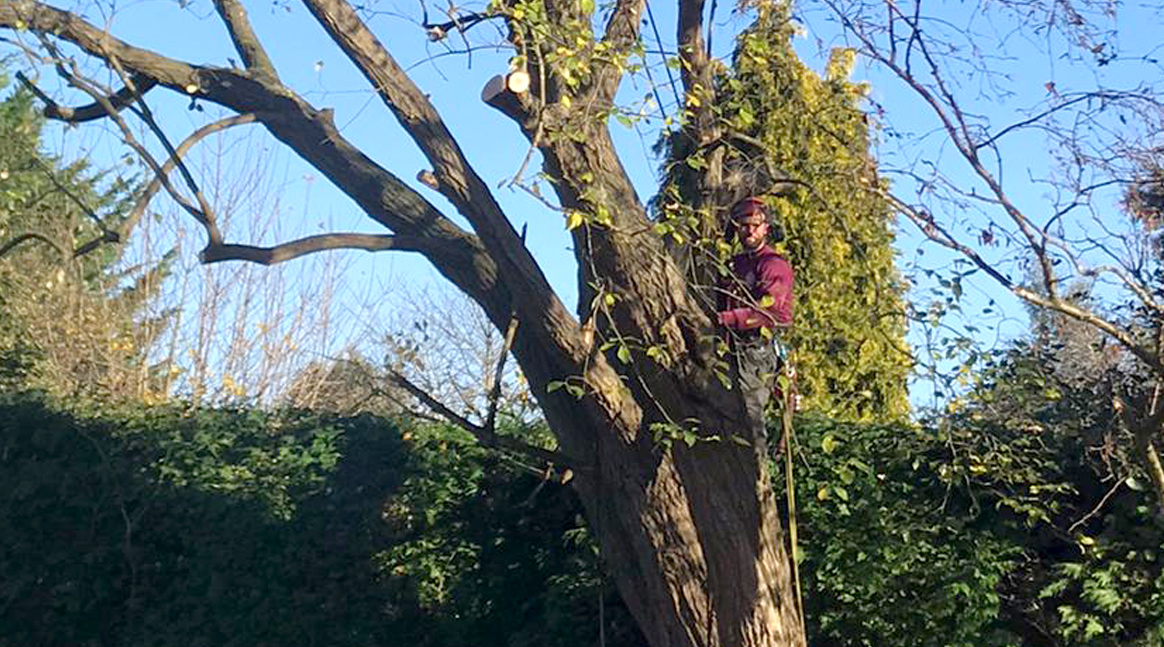
Trees are built to withstand changing weather conditions, and the presence of a large or mature tree does not mean that it is automatically dangerous.
However, trees can become weakened by age, damage, disease or previous structural problems, and winter weather may expose existing weaknesses.
Autumn is therefore a sensible time to inspect trees around homes, businesses and other frequently used areas.
Identifying a potential problem early provides an opportunity for professional assessment before strong winds and periods of severe weather arrive.
Here are some of the warning signs that may justify a closer look.
1. Dead or Hanging Branches
Dead branches are a normal part of the lifecycle of many trees and can also provide important habitat for wildlife.
Their location is what often determines whether intervention is necessary.
A substantial dead branch above an unused part of a woodland may present very different considerations from one above a driveway, footpath, garden seating area or building.
Where dead, diseased or failing branches present a foreseeable safety concern, professional deadwood removal may be appropriate.
Chartfords Trees provides specialist tree safety work, including deadwood removal and cable bracing where suitable.
2. Recently Broken Branches
A branch that has partially broken but remains attached to the tree can require prompt attention.
Even relatively modest branches can be extremely heavy, particularly when falling from height.
Do not attempt to pull down hanging branches or climb into the tree yourself.
An experienced tree surgeon can assess how the damaged section can be removed safely while minimising unnecessary damage to the remaining tree.
3. Significant Cracks or Splits
Visible cracks within major limbs or where branches join the main structure of a tree should not automatically be ignored.
Not every crack means that a tree or branch is about to fail, but substantial structural changes warrant professional assessment, particularly where the tree is close to buildings or areas regularly used by people.
The solution will depend on the individual tree.
Pruning may sometimes help reduce mechanical stress on particular limbs. In selected circumstances, cable bracing can provide additional support to important trees with large or heavy limbs.
4. A Tree That Has Started Leaning
Many perfectly healthy trees grow at an angle.
A longstanding lean is therefore not necessarily a problem.
What is more significant is a new or noticeably increasing lean, particularly following storms or ground disturbance.
Changes around the base of the tree or movement in the surrounding soil may also provide useful information.
If you believe a tree has recently changed position, arranging a professional inspection is advisable rather than attempting to judge its stability yourself.
5. Branches Touching Your Property
Trees can gradually grow closer to buildings without the change being particularly noticeable from year to year.
Eventually, branches may begin touching roofs, windows, guttering or walls.
This does not always require major tree reduction.
Selected lateral branches can often be reduced away from a building while retaining the broader structure and appearance of the tree.
Professional tree pruning allows the appropriate technique to be selected according to the species, condition and desired result.
6. Large Amounts of Deadwood
A few small dead twigs are very different from substantial dead branches throughout the canopy.
If a tree appears to contain a significant quantity of deadwood, particularly where large limbs are affected, professional assessment can help establish what action is appropriate.
The aim should be to address genuine risk without unnecessarily removing habitat or healthy tree material.
Chartfords Trees takes the age, health, species and location of individual trees into account when recommending work.
7. An Unbalanced or Overextended Crown
Trees do not always develop evenly.
Previous pruning, competition for light, storm damage or the surrounding environment can contribute to an irregular canopy.
Large overextended limbs may place additional mechanical stress on particular parts of a tree.
Depending on the circumstances, techniques such as crown reduction or crown thinning may help manage the structure.
However, excessive pruning can itself damage a tree, so any substantial reduction should be properly planned.
Our main tree surgery services page explains the different pruning and management techniques available.
8. Previous Storm Damage
A tree can survive a storm without falling but still sustain damage.
Broken smaller branches may be obvious immediately, while other structural changes can be much harder to identify from the ground.
If a significant tree has recently experienced storm damage, especially one close to a house, road or public area, it may be sensible to have its condition professionally assessed.
The objective is not necessarily to remove the tree. Often the first question is whether appropriate management can allow it to be retained safely.
Does a Dangerous-Looking Tree Have to Be Felled?
No.
Tree removal is only one possible solution and should not be assumed to be necessary simply because a tree has become large, overgrown or has suffered some damage.
Appropriate pruning, deadwood removal, crown management or bracing may sometimes allow an important tree to remain.
Where a tree genuinely cannot be safely retained, however, professional tree felling and removal may be necessary.
Where there is enough space and conditions allow, a tree can sometimes be felled in one section. In more restricted environments, it may need to be dismantled progressively using specialist equipment and techniques.
Remember Tree Preservation Orders and Conservation Areas
Even where work appears necessary, protected trees cannot simply be pruned or removed without considering the relevant regulations.
A Tree Preservation Order can restrict work to an individual tree, while Conservation Area status can also introduce notification requirements.
Chartfords Trees carries out checks during the quotation process and can handle appropriate TPO and Conservation Area applications.
Where an immediate safety issue exists, professional advice should be sought on the correct course of action.
Can You Inspect a Tree Yourself?
A homeowner can certainly keep an eye on their trees from ground level.
In fact, familiarity with how a tree normally looks can make it easier to spot significant changes.
However, a visual check from the garden is not the same as a professional arboricultural assessment.
Do not climb a tree, use ladders to inspect branches or attempt to cut large limbs yourself.
Tree surgery often involves significant weight, work at height, specialist cutting equipment and complex control of falling branches.
Professional Tree Safety Work Before Winter
The purpose of an autumn tree check is not to assume that every tree is dangerous.
It is simply to identify changes that might justify professional attention.
If a mature tree has developed dead or hanging branches, appears to have moved, has suffered storm damage or is causing concern because of its proximity to buildings, obtaining professional advice can provide a much clearer picture of what—if anything—needs to be done.
Chartfords Trees is a well-established tree surgery company serving Oxted and the surrounding areas. Our employed and trained arborists carry out professional pruning, safety work, tree removal, stump grinding, hedge maintenance, planting and other arboricultural services for domestic and commercial customers.
To arrange an assessment or free, no-obligation quotation, call 01883 460 160 or contact Chartfords Trees.